Winds of the world: Tramonte, France
The French navy’s maritime surveillance station (Semaphore) at Cape Leucate. Photo by Maël Balland.
This post is part of Wind Series: Where I analyse locations of strong or otherwise peculiar wind patterns.
“Everyone talks about the weather, but nobody does anything about it”, wrote Charles Warner in 1897. I learnt that quote from a book called Weather by William Burroughs. As a windsurfer and aviation enthusiast, the topic is close to my heart.
I learnt to windsurf in Leucate, France as young kid. The place had a perfectly flat lagoon with a steady and reliable wind that the locals called Tramonte (officially Tramontana, I reckon). It is similar to Mistral in its formation.
Today, we analyse why the Tramonte wind exists.
Standard wind analysis framework
I like to create frameworks. They establish a perceived completeness about a topic and also contain my curiosity that can sometimes escape beyond what is useful. For the purpose of talking about winds, I created the below structure to anchor key analysis factors.
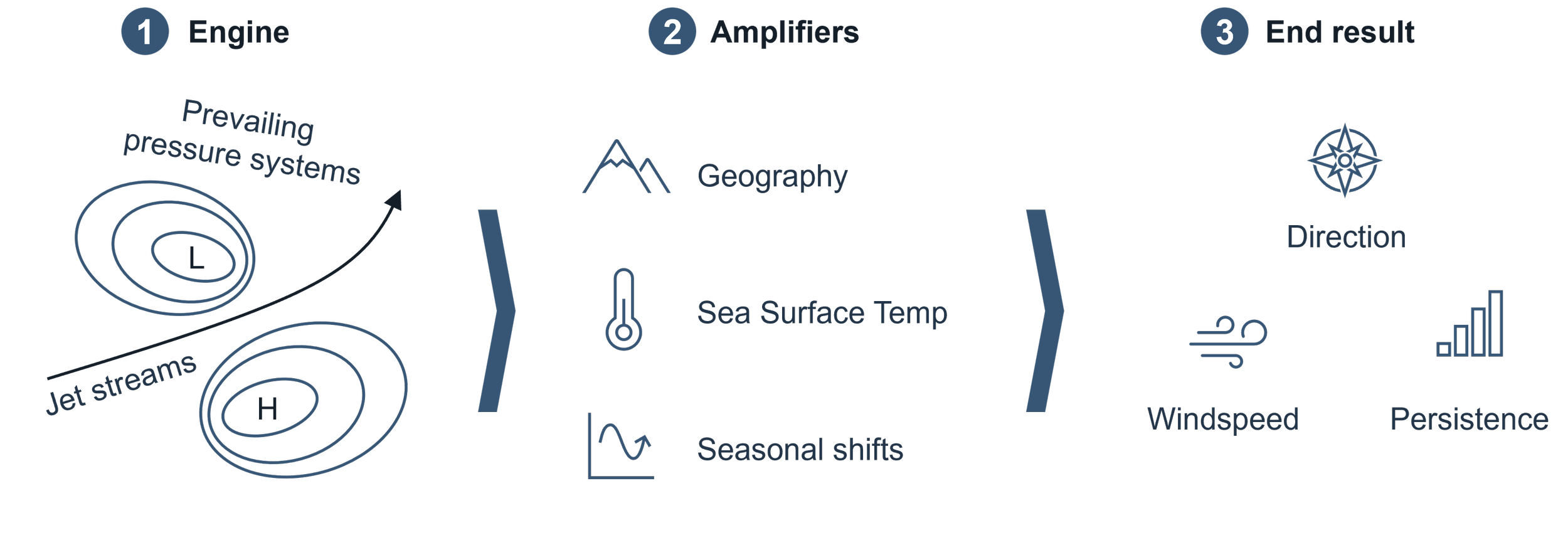
Wind analysis framework by Orbital Vantage
1. The Engine
Wind flows from high pressure areas to low pressure areas. In Tramonte, the prevailing pressure systems are a strong high pressure area over the Atlantic or Iberia, and a low-pressure system over Gulf of Lion & Italy.
These two pressure systems are prevalent, as seen in the 25 year data period below. It shows which areas are dominantly high pressure (shades of orange) and low pressure (shades of blue) during a typical year.
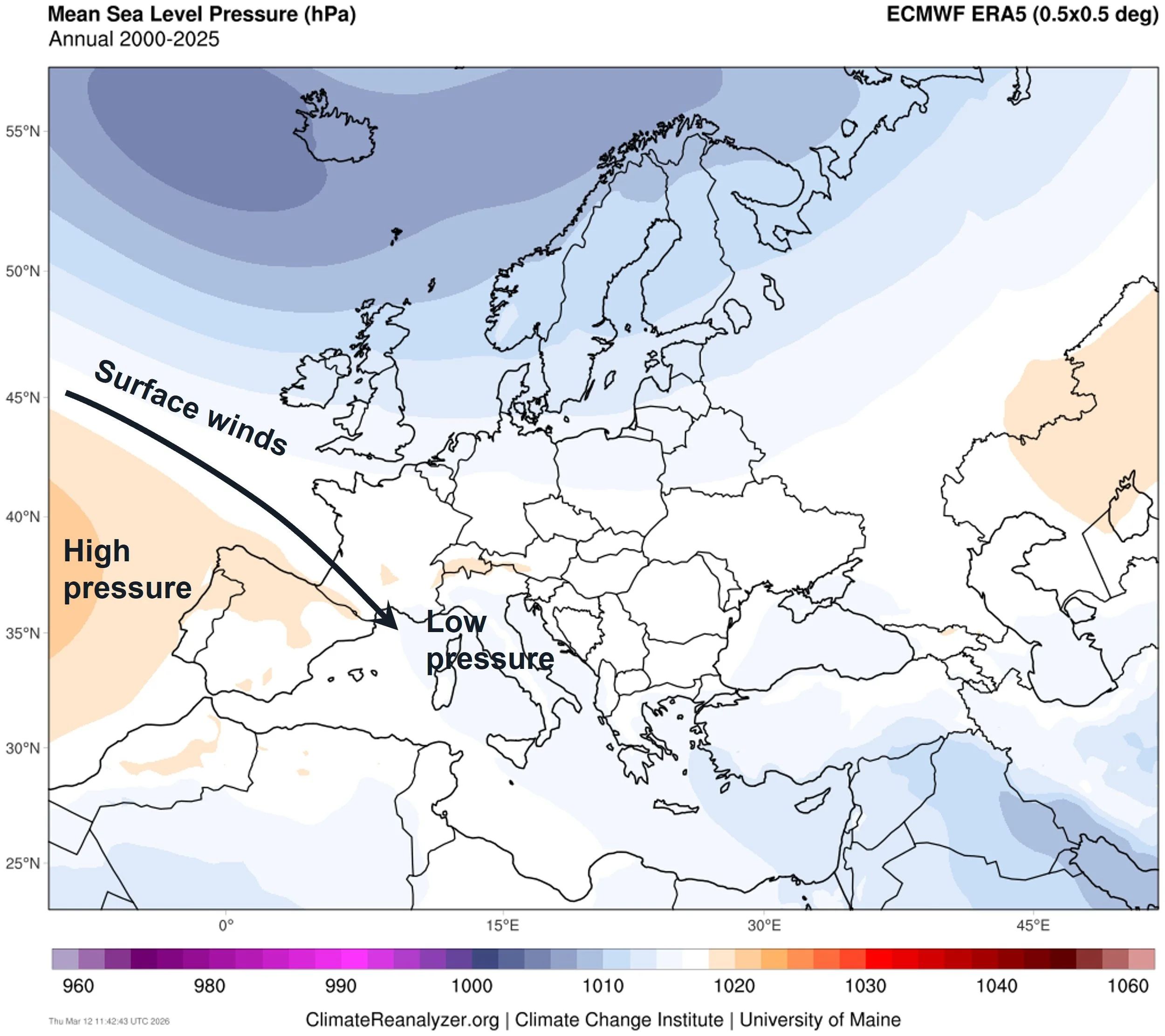
Prevailing pressure systems around Europe between 2020-2025.
There is a also dominant jetstream from Northwest to Southwest, which supports these pressure systems, but that is not critical to understand for Tramonte.
2. The Amplifiers
Geography
Wind flows like water around obstacles. In Tramonte, the Pyrenees block the flow in the south, and the Massif Central in the North. They naturally funnel the wind, which heavily increases windspeed (called Venturi effect). This is marked on the map below.
Surface roughness plays another part: Over land: Trees, hills and buildings slow the flow. When the wind enters over Gulf of Lion, friction drops and wind speed increases.
Where wind has flown over elevated terrain like around Montpellier, oscillating waves are created to the flow which can cause strong gusts downwind from the terrain (see our separate post about bow wave clouds related to this).
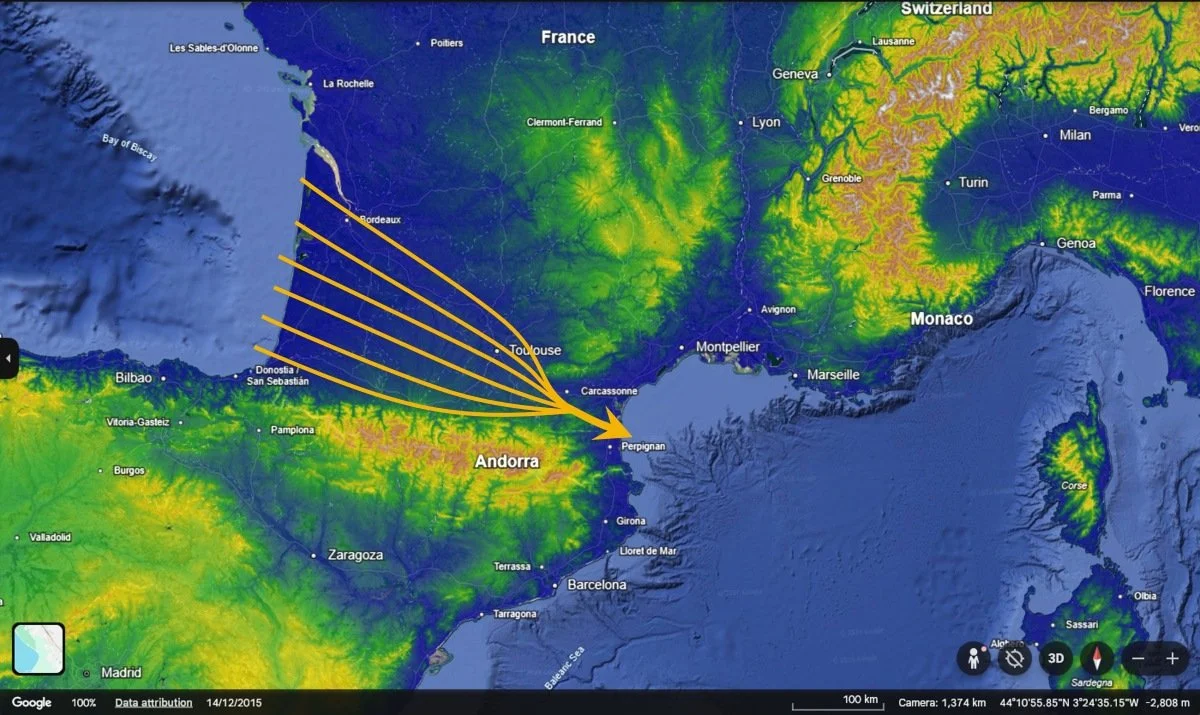
Illustration of the Tramonte Venturi effect with terrain elevation.
Sea Surface Temp (SST)
Sea surface temperatures are not a key amplifier for Tramonte.
Seasonal Shits
While not a seasonal wind, spring tends to create the strongest pressure differences between the cold atlantic high and warmer mediterranean low. Though looking at monthly pressure system anomalies, these shifts are subtle and episodic.
3. The End Result
The end result is strong and stable wind with episodic very high velocities, that is felt mostly at coastal areas and water over Gulf of Lion. The density map below illustrates the accumulating wind energy in purple.
The average annual wind speed is 9.5m/s near the coast, with a remarkably steady flow from Northwest. Stronger spells can frequently reach higher wind speeds of 30m/s and last from days to a week.
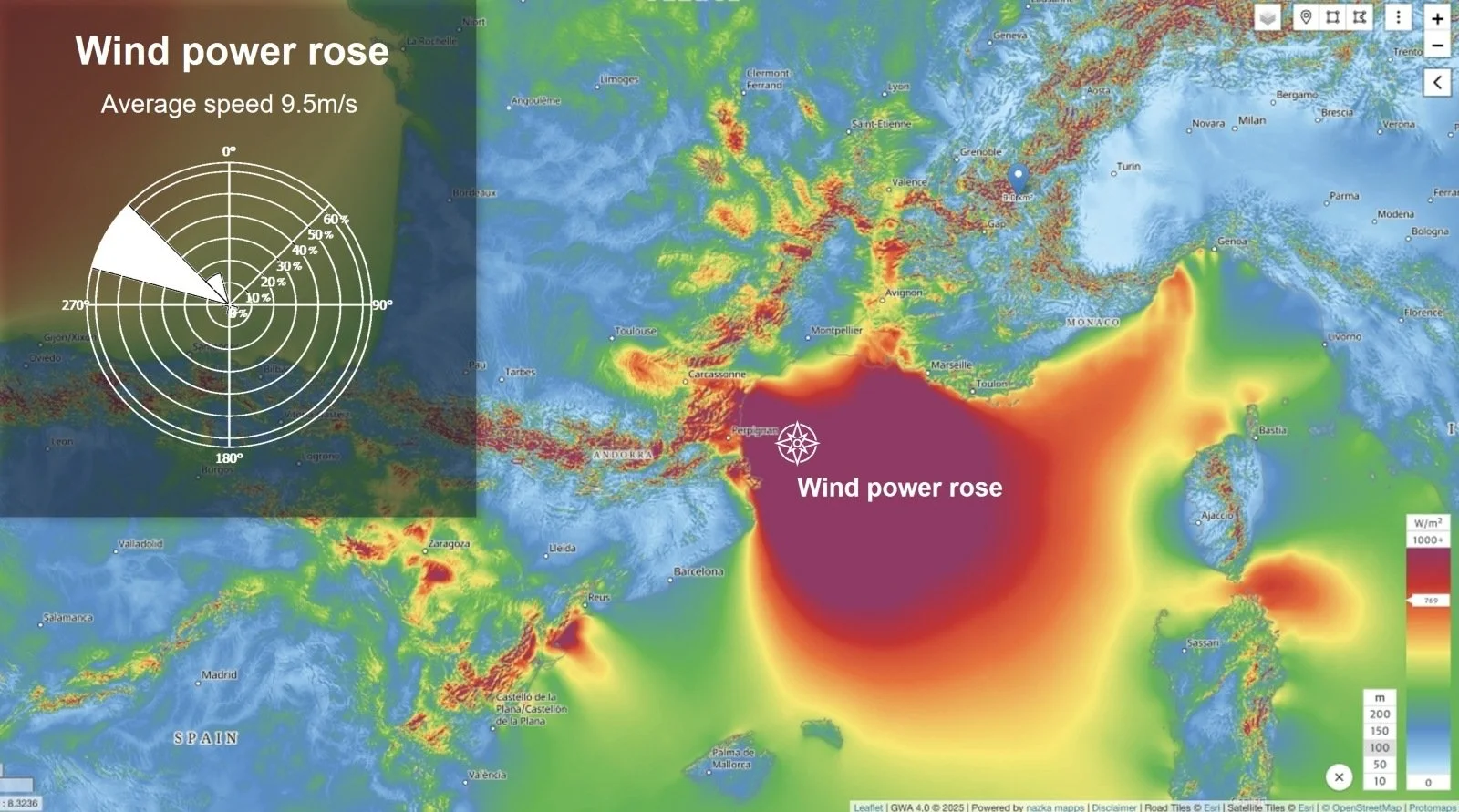
Wind energy accumulation map showing the Tramonte area in Purple.
Finally, as this is an Earth Observation -led site, below is a SAR-scene over the Gulf of Lion on October 23rd 2025. This was a day with strong gusts of over 30m/s throughout the day. The white areas are not clouds in the scene below, but the sea surface being roughnened and streaked by Tramonte.

Tramonte effects on Gulf of Lion in a Sentinel-1 SAR (radar) view
Conclusion
The Tramonte is a reliable wind generated by prevalent large-scale pressure systems over the Atlantic and Mediterranean, and amplified by Pyrenees and Massif central.
For windsurfers, this wind is true power. Not only is it constant and frequent, but comes offshore meaning the water near the beach is flat and easy to sail on. Not surprisingly, these conditions are also excellent for wind energy.
See you,
Orbital Vantage
