Winds of the world: Roaring forties on Cook Strait, New Zealand
Wind-whipped seaspray around New Zealand south island with a seagull holding on for dear life. Photo by Tuomas Vuorinen
This post is part of our “Wind series”, where we explain the formation of strong or otherwise peculiar winds.
Many kiwis have told me they moved out of Wellington because of the weather. One moved to London, though admitted that perhaps wasn’t fully thought out. I studied for a year in Wellington and enjoyed the city and its weather tremendously. But it was indeed windy.
Today, we continue the wind series and look at the Southern Hemisphere westerlies, the Roaring Forties, that often create rough conditions on theCook Strait between New Zealand’s North and South islands.
Standard wind analysis framework
We apply the Orbital Vantage wind analysis framework to anchor key variables.
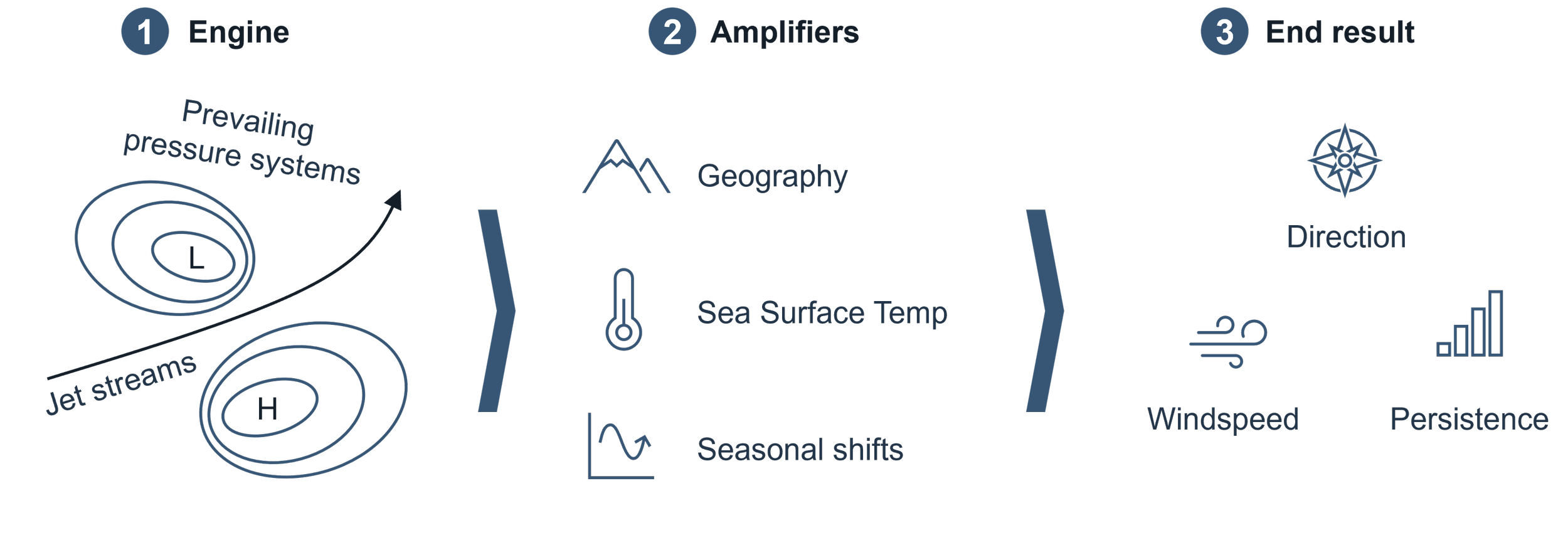
1. The engine
Weather around the Earth’s poles is complex and fascinating, defined by deep and persistent low pressure systems.
To appreciate this swirling engine, the below scene from Windy is a great illustration. The blue areas are low pressure areas, with local cyclones marked with a rotating icon. The red areas are higher pressure areas. Together, they generate winds that meet at what is called the sub-tropical convergence zone marked with a dotted line. This system is our wind engine.
The Antarctica low pressure system visualised as the core of the engine.
Pay attention to what is happening in the image above over New Zealand. A low pressure frontal system has detached from the polar area. It moves east along the convergence zone, bringing with it episodic stronger winds. This is a great coincidence and we’ll analyse it as part of our wind amplifiers.
2. Amplifiers
Geography
The southern ocean is free of obstacles, but where land mass reaches south the wind is amplified around it.
This is the key in New Zealand. The Southern Alps stretch 800km along the South Island with peaks over 3km. Then there is the Cook Strait, a 30km gap between the islands that works like a valve. It is west-east oriented, making it highly effective at channeling the westerly wind, as indicated below.
Elevation profile of New Zealand and the windflow through Cook Strait visualised.
SST
Sea surface temperatures around New Zealand vary significantly, from 20-degree subtropical waters in the north to colder 5-10 degree subantarctic waters in the south.
This does not directly amplify the strong winds, but it contributes to the formation of frontal systems.
Seasonal variation
This is not a seasonal wind, but during winter the temperature and pressure contrast between Antarctica and mid-latitudes increases. The westerly wind flow intensifies and shifts slightly north. This also contributes to the formation chance of frontal systems.
Episodic accelerators: Frontal systems
Embedded within the steady west-to-east wind flow are travelling low-pressure systems (cyclones), formed by the pressure and temperature differences around this latitude. See below a slider image of this in action around New Zealand, with gusts reaching well over 30m/s in purple areas.
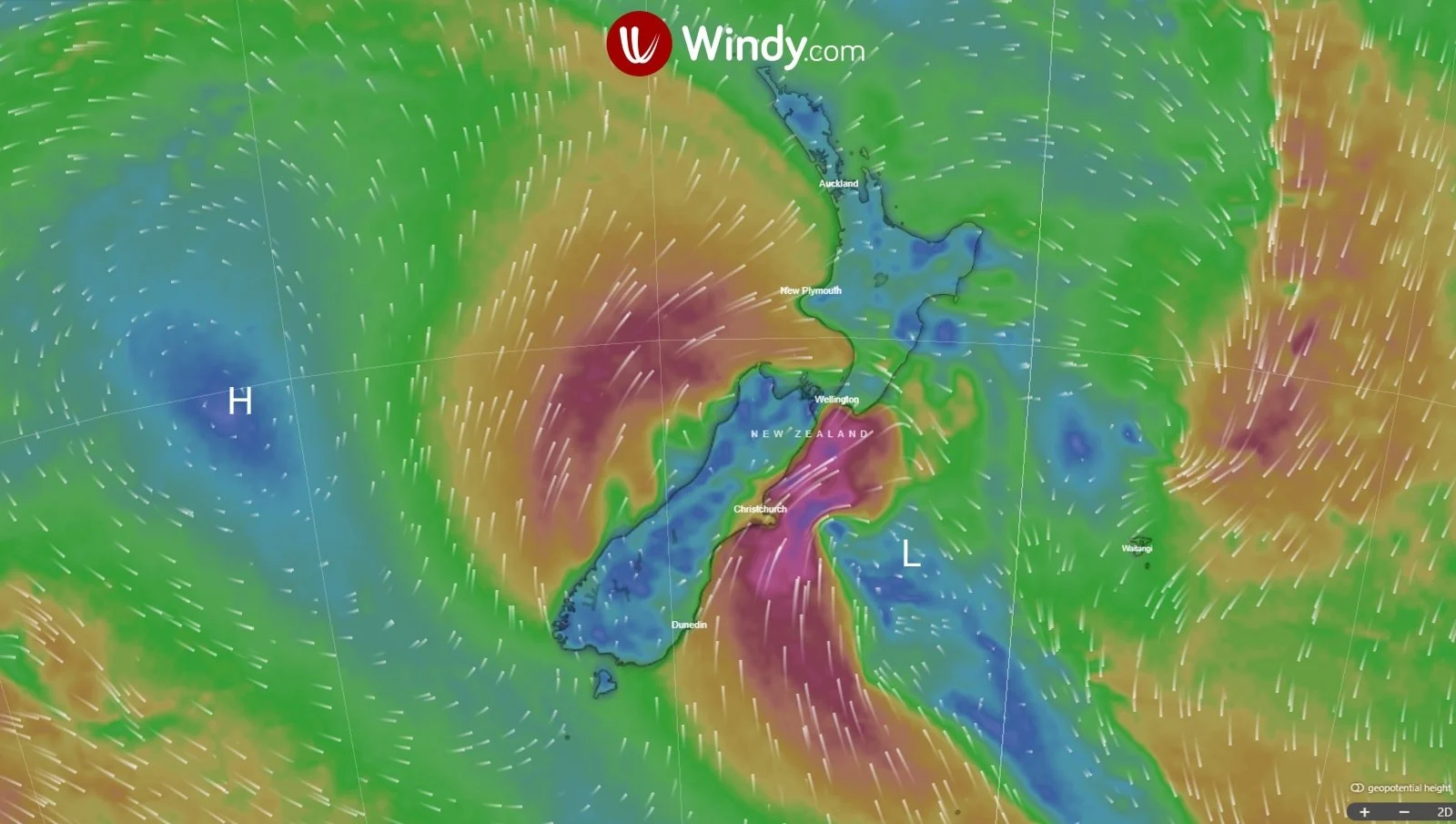
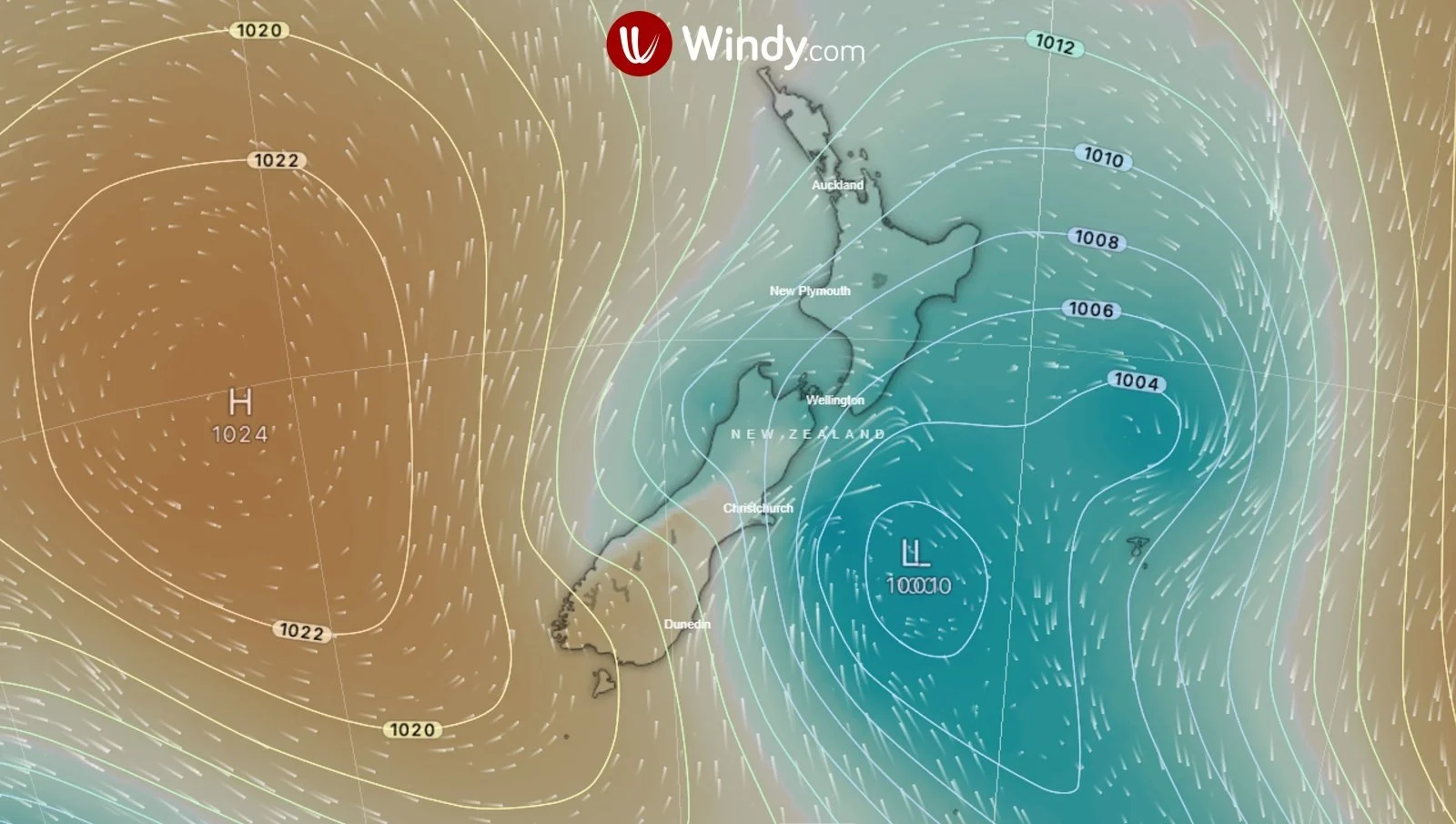
We can see how the high pressure area on the western side creates counter-clock-wise winds that are amplified on the western coast, and the same happens for the low-pressure system winds on the eastern side.
When one of these lows passes near New Zealand, it shifts wind direction from typical direction and greatly amplifies local wind speeds.
3. The result
The combination of the sub-tropical convergence zone with strong pressure differences, and the channeling geography of New Zealand produce strong and steady winds that reach their peak at the Cook Strait. The average annual wind speed on the strait is 10.6m/s and comes from North-Northwest.
Roaring Forties is the yellow wind belt circling the Southern Hemisphere.
Wind energy accumulation map showing the Cook strait and surrounding ocean in purple. Notice also that the wind speed picks up over the mountains and hilly regions on both islands, creating even gusty local conditions.
Conclusion
The constant low-pressure engine of the pole creates The Roaring Forties: A global wind engine that produces a strong, steady and unimpeded wind that circles the southern hemisphere.
In New Zealand and particularly Cook Strait, this wind and the related traversing storm systems are amplified by near-perfect funneling geography.
This makes the Cook Strait crossing a real experience for ferries, exciting landings on the short Wellington international airport, and good conditions for producing wind energy.
See you,
Orbital Vantage
