The geographical advantage of Middle East airports
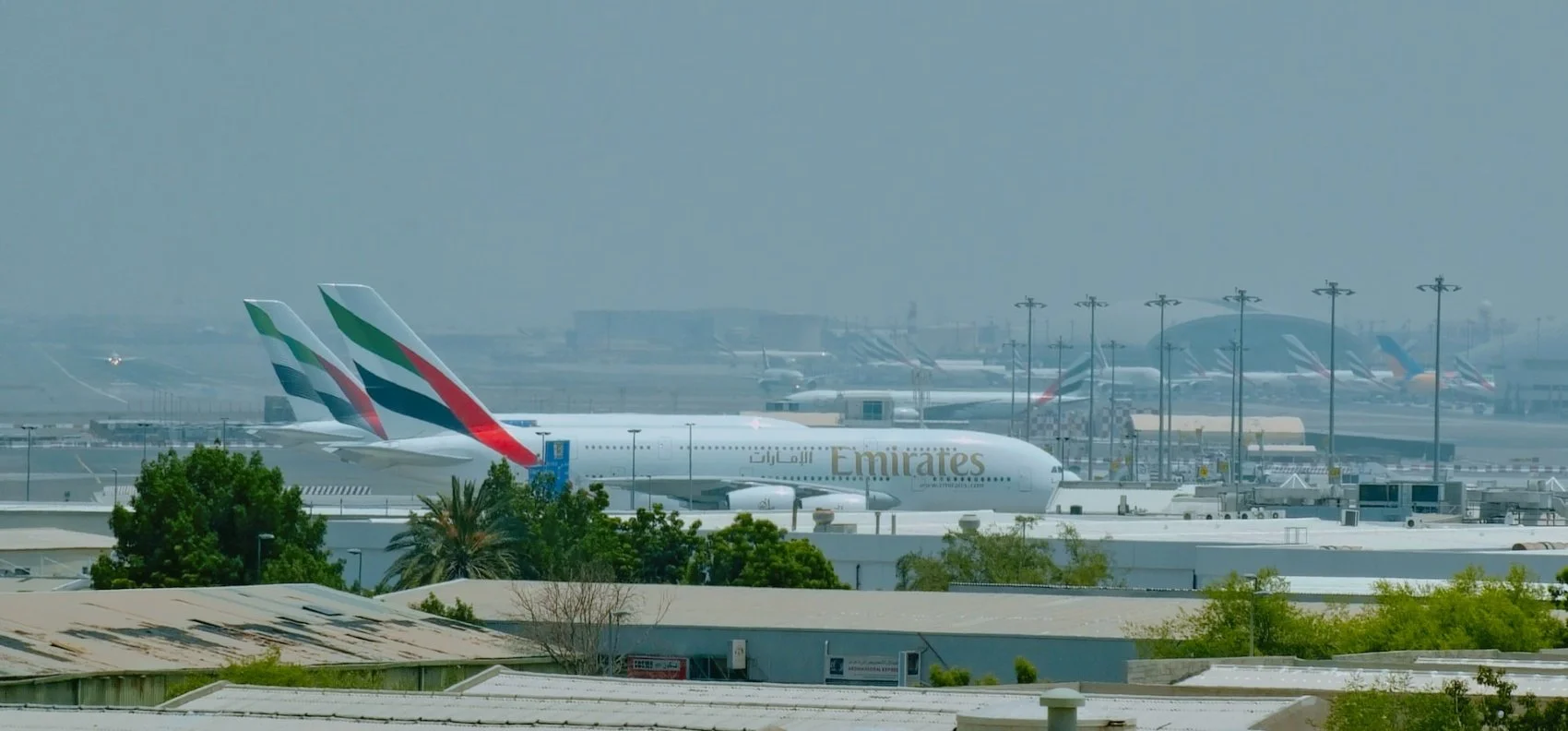
Emirates A380 parked at Dubai OMDB. Photo by Muhammad Ahmad.
This post is part of the “Why here?” infrastructure series, where we explore why critical infrastructure sits where it does.
Ten years ago my team lost a great GIS analyst, so my boss suggested I learn it. I instead helped hire a new analyst. Following my boss’s advice would have helped me with this one.
Today, we explain why global super-connector airports like Dubai are found in the Middle-East. More importantly, Orbital Vantage gets to work with its true passion for the first time: Aviation.
1. The need: Connecting a changing world
Connect economic growth
Before explaining Dubai, it helps to understand what problem air traffic solves.
For much of the 20th century, global aviation was dominated by the transatlantic corridor. Flights between North America and Europe following interconnected economic development trajectories formed the backbone of long-haul travel. The geography is easy to understand: Large, wealthy populations on both sides of the Atlantic within manageable flight distances.
Like the data below shows, economic gravity has shifted. Asia has grown into the world’s largest economic region and trade flows increasingly run between Europe-Asia (and North America - Asia). These flows are longer, more complex and more dispersed than the old transatlantic routes.
Economic growth of key regions
Connect population
If you look at today’s population map from an orbital perspective, you’ll notice the densest population clusters on Earth are in Asia. Connecting these global populations efficiently is the core challenge of modern aviation.
World population density heatmap shows largest and densest populations in Asia.
2. Why the traditional city-to-city approach fails over long distances
The need is quite simple, so why don’t we just fly directly between all the cities between Europe-Asia and Africa-Asia?
This chapter explains the network dynamics. If you want to skip straight to the Middle East strength, skip to Chapter 3.
Problem: City-to-city fails over long haul distances
The old model of direct point-to-point flights struggles here. Distances are long, demand between specific city pairs can be thin, and operating ultra-long-haul routes is expensive and operationally complex. I visualized this with the below graphic.
Air route viability without connector airport is weak
It is a hypothetical exercise of people wanting to fly from cities A,B,C to cities X,Y,Z. Problem is, there are not enough passengers to sustain all city pairs:
Only routes A→X and B→X are viable with 300 passengers and served with e.g. A350.
On route C → X, only 50 people want to travel. No aircraft can economically serve that route. These people would fly through other cities closer by, but it wouldn’t solve the problem at large scale
What the system needs is a connector. A place where flows can meet, redistribute and continue.
Solution: A connector improves viability on all routes
Let’s now place a connector between the cities in the graphic.
Air route viability increases dramatically with a connector airport
Passenger demand hasn’t changed, but now all the routes become viable:
Destination X is the most popular with 650 passengers. This can be served either with two A350s or in theory one A380.
The 50 people from city C→X first fly into the Connector together with people going to other cities. They are grouped with other arrivals and onward they all go.
Now consider real-world complexity: There are dozens of cities on both sides and the connector works to service them all.
There are other benefits like more efficient crew utilization, but today it is sufficient to say the connector creates plenty of operational synergies for whoever stands in the middle.
3. Why the middle east wins as a connector: Case Dubai
Let’s now place an orthographic map centered on Dubai to understand its strength as a connector. As a sidenote, this is where I fought QGIS like Don Quixote fought windmills and resisted the urge to call my old day job colleagues to do it for me.
Global population density and 6500km range from Dubai. 75% of world population is inside that circle.
Within a 3,500 nautical mile radius sits most of the world’s population. Europe, India, Southeast Asia, China and Africa fall within reach. QGIS calculates 6.24bn people based on 2025 population data inside the circle. That’s 75% of the world’s population within a ~8 hour flight.
From this vantage point, Middle East is central. This position fully enables the benefits outlined in chapter 2.
4. Why not elsewhere?
If geography is so influential, why didn’t the connector emerge somewhere else? There are several candidates on paper:
Central Asia sits in the right position between Europe and Asia. But the region lacks the capital, stability, and coordinated aviation strategy needed to build and sustain a global hub.
Helsinki is a more interesting case. Finnair built its strategy on connecting Europe and Asia over the polar route and it worked well until Russian airspace closed. But it is also too far north for Southeast Asia and ultimately lacks the capital scale to compete.
Istanbul comes closest. It has strong geography and large nearby populations, and it has indeed developed into a major hub. But it sits more West and operates under more complex airspace and political constraints.
India, especially Mumbai, is arguably even closer to the global population center. But here, non-geographic factors dominate: Congestion, infrastructure constraints, and political complexity make a connector strategy harder to execute.
The Gulf pulled ahead. State-backed investment enabled rapid scaling and airlines were built around the hub model from the outset. Infrastructure was developed ahead of demand rather than in response to it, and of course there was plenty of space to build.
Conclusion
From orbit, the logic behind Middle Eastern superconnector airports is easy to see as sitting in the middle of key population clusters., though the full explanation greatly benefits from information regarding population densities, economy and even air route network dynamics..
Even then, that geographic advantage is the basis for a competitive advantage. On top of it sits execution: Capital, infrastructure, stability and a network model designed to exploit the geometry, which the Middle East’s stated-backed airports and airlines have done exceedingly well.
See you,
Orbital Vantage
